
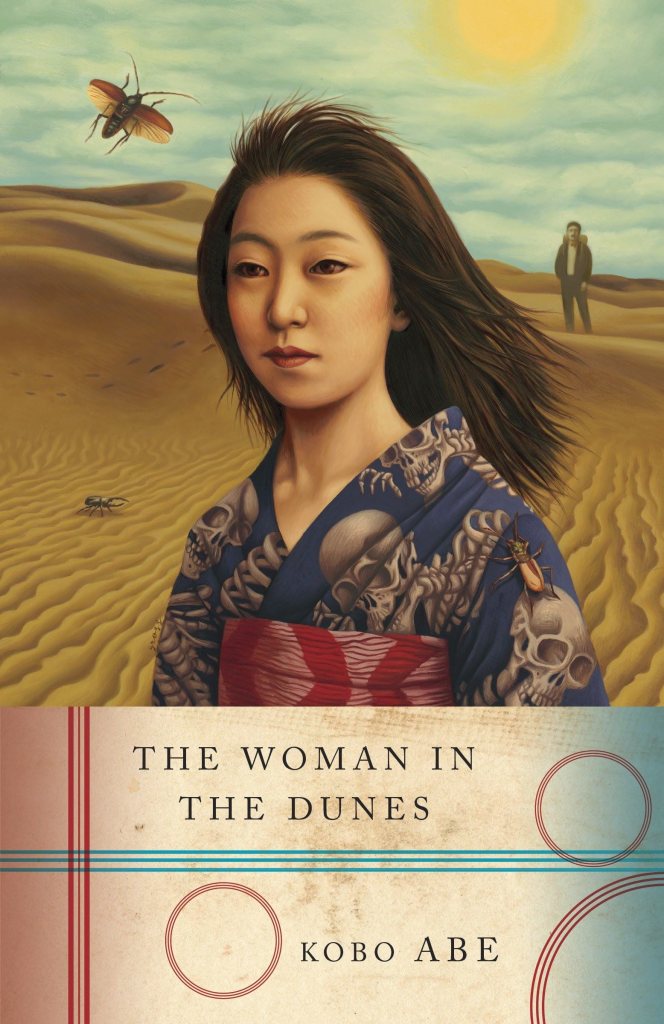
Title: The Woman in the Dunes
Series: N/A
Author: Kōbō Abe
Translator: E. Dale Saunders
Genres: Literary, Surrealism, Magical Realism
Publishing Date: 8 June 1962
Original Language: Japanese
Pages: ~256
CW: Confinement, Kidnapping, Misogyny, Rape, Sexual content, Sexual violence, Child death, Pregnancy, Violence
NOTE: Book purchasing links may be affiliate links, where I receive a small commission at no added cost to you.
Read if you’re looking for:
- A surrealist classic of Japanese literature
- Translated from Japanese & written in the 1960’s
- Existential dread
- Feelings of claustrophobia
- Themes that still hold up today & can be applied as a critique of capitalism
- A story that takes place in one location & with mainly two characters
This is a classic of Japanese literature, written by one of Japan’s most well-known authors. The story follows a man who is taking time off from his teaching job to do some amateur entomology, looking for insects to catalogue in the sand dunes along the coast. When he spends a little too much time there, and misses the last bus of the day, he encounters a small village and asks if he can stay the night. In the dark, a villager leads him to a rope ladder and tells him to climb down to stay with one of the women of the village for the night. The man spends the night, judging the woman and her ramshackle hut, but realizes in the morning that he is now trapped in the dunes, at the bottom of a sand pit and at the mercy of the villagers above. The woman informs him that they had better start working to shift the sand, bucket by bucket, to prevent the village from being consumed. If they don’t work, they won’t be given water. The story then follows the man’s anger, despair, and attempts at rebellion while he psychologically devolves to a calamitous ending.
I am not the best person to be analyzing this book, as I’m not familiar with the social issues of post-war Japan. But, I feel that this book’s themes can still be more universally applied to capitalism today.
The most obvious parallel to modern, American culture I can see is the existential dread of toiling away at a meaningless task, day after day, just to earn the basic essentials of life. The sand blows back in every day and the villagers must engage in back-breaking work to shovel it out to prevent their homes from being completely covered, day in and day out, with no respite. If they don’t complete their work, the leaders of the town withhold their water ration. As the days and months go on, the main character realized that most of the villagers are being held hostage in this way, with a few leaders controlling the water source. He desperately tries to escape, and goes through many stages of anger and grief about his situation, until he eventually resigns himself to it. He and the woman he is paired with are also expected to procreate to make more workers for the village.
Additionally, when the man first interacts with the woman in the dunes, and the other villagers, he is often thinking about how important he is in comparison to them. He is convinced that his co-workers on the outside will be concerned that he is missing and send out the police to look for him. As the days go on, he realizes that no one is coming to rescue him. He clearly sees himself as better than the villagers, and of a higher class, and is surprised at how quickly he is absorbed into their life in the village as if he had always been there, emphasizing a class divide and how poorer people are seen by others. More on the theme of class differences in post-war Japan can be read in this article from The Japan Society of the UK.
The writing in this novel has a dreamlike quality that is evocative and claustrophobic, with Abe making you feel the desperation and thirst of the two main characters, the male MC and the woman he is paired with. There are also a lot of parallels between sexual desire and thirst. I really enjoyed the writing style and the smart critique of social issues in this book, even though the content was fairly upsetting (which was the point). A warning here as well, for sexual assault, and one disturbing scene of rape near the end.
I can see why this book is considered a classic. It really delved into social issues and existentialism in really compelling way, and the writing was great. Readers who enjoy work by Albert Camus or Franz Kafka, or more modern dystopian fiction, would probably find this book engrossing. However, avoid picking this up if you are not in the mood for darker themes.

Leave a comment